Social Agents

How @chibluindia's Instagram runs on agents.

We stopped writing posts. We started approving them. Six small agents, one tap on Telegram, and a feed that no longer dies on Week 3.

6
Agents
15 min
Per week
1 tap
To approve
0
Social hires
The loop in twenty seconds — a draft lands on the phone, a tap approves a variation, it schedules itself, and the auto-publisher posts it later. The rest of this piece is what's behind that single tap.

Chiblu is a curated marketplace for Indian craft — weavers, ceramicists, woodworkers, the kind of work that takes weeks to make and seconds to scroll past. Instagram is where buyers find us and where makers see whether we treat the work with care. The feed mattered.

The feed also kept dying. Week one we'd post daily. Week two, every other day. Week three, silence. Hiring a social-media person felt premature for the size of the storefront. So we built a team of small agents instead — each one handling a single event — and shifted our job from making posts to approving them.

This is how it works at Chiblu.


The starting point

A few things had to be true at the same time.

The default answer — "draft, polish, schedule manually" — collapsed under those four constraints. So we unbundled it.


A team made of agents

Six agents, each watching for one kind of event.

Every agent has a narrow job and a clear trigger. The schedule agent doesn't know about festivals. The festival watcher doesn't know about new arrivals. The auto-publisher doesn't care what created the draft — it just looks for approvals.

Schedule Agent
Runs · Every week

Picks a featured product · writes a caption · creates four design variations.

Festival Watcher
Runs · Every morning

Checks today against the Indian festival calendar. Pongal, Holi, Eid, Diwali, Christmas.

Seller-Campaign Agent
Runs · Every Sunday

Rotates through twelve maker-recruitment angles for chiblu.com/seller.

New-Arrivals Scanner
Runs · Every day

Scans Chiblu's catalog · queues a draft for each new product across the next week's slots.

Caption Writer
Runs · For every draft

An AI writer trained to match our voice · picks one italic-gold accent word per post.

Auto-Publisher
Runs · Every hour

Publishes approved drafts to Instagram exactly when they're scheduled to go out.


The calendar

The surface we look at when we want to know what's coming.

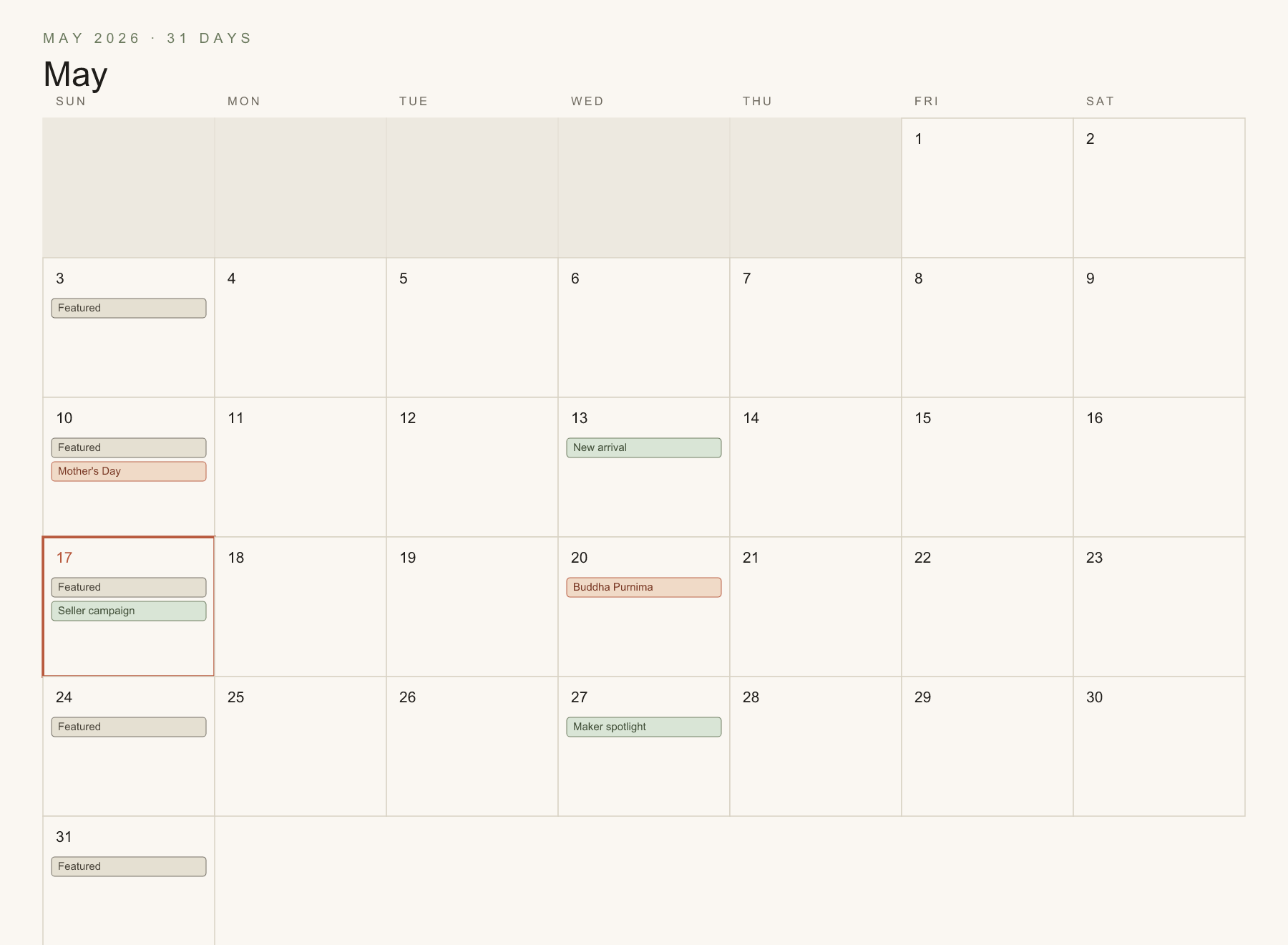
Month grid showing chips on multiple days — festivals in terracotta, recurring posts in muted gold, pre-generated drafts in sage
One month, multiple sources. Each chip is one fire — festivals on their date, recurring posts on their weekly cadence, pre-generated drafts on the date they'll publish.

Each chip is one fire. Festivals show up on their date. Recurring posts on their weekly cadence. Pre-generated drafts on the date they'll publish. One button at the top — Generate all drafts for May — runs the pipeline for every empty cell in the month. It skips cells that already have a draft, so we can re-run it anytime without duplicates.

Clicking a chip drops us into a per-fire page: the caption that'll go out, the four design variations, a template override picker if we want this Wednesday to be a carousel instead of a single post. Generation happens server-side and lands as a draft we can approve later.


One tap, on Telegram

The web view is for planning. The approving happens on Telegram.

Sunday morning at 8 AM IST, the team gets a digest message listing every draft scheduled for the coming week. Each draft arrives as a swipeable album of four design variations, with a message underneath holding six buttons: 1, 2, 3, 4, (regenerate), (skip). The video at the top of this piece is one of these reviews, end to end.

Tapping a number doesn't publish immediately. It marks the draft as scheduled. When its scheduled time arrives, the auto-publisher posts it to Instagram. Sunday's tap → Wednesday's post.

The split between approval and publish is the load-bearing part of this. We clear the week in 10 minutes without thinking about timing.


What it makes

The agents reach for different layouts depending on the event.

Editorial when the photograph carries the story, typography when the message itself is the visual, festive blocks when the calendar says it's the day. A few of them, side by side:

Magazine Cover layout — full-bleed product photo with editorial typography overlay
Magazine Cover · Featured
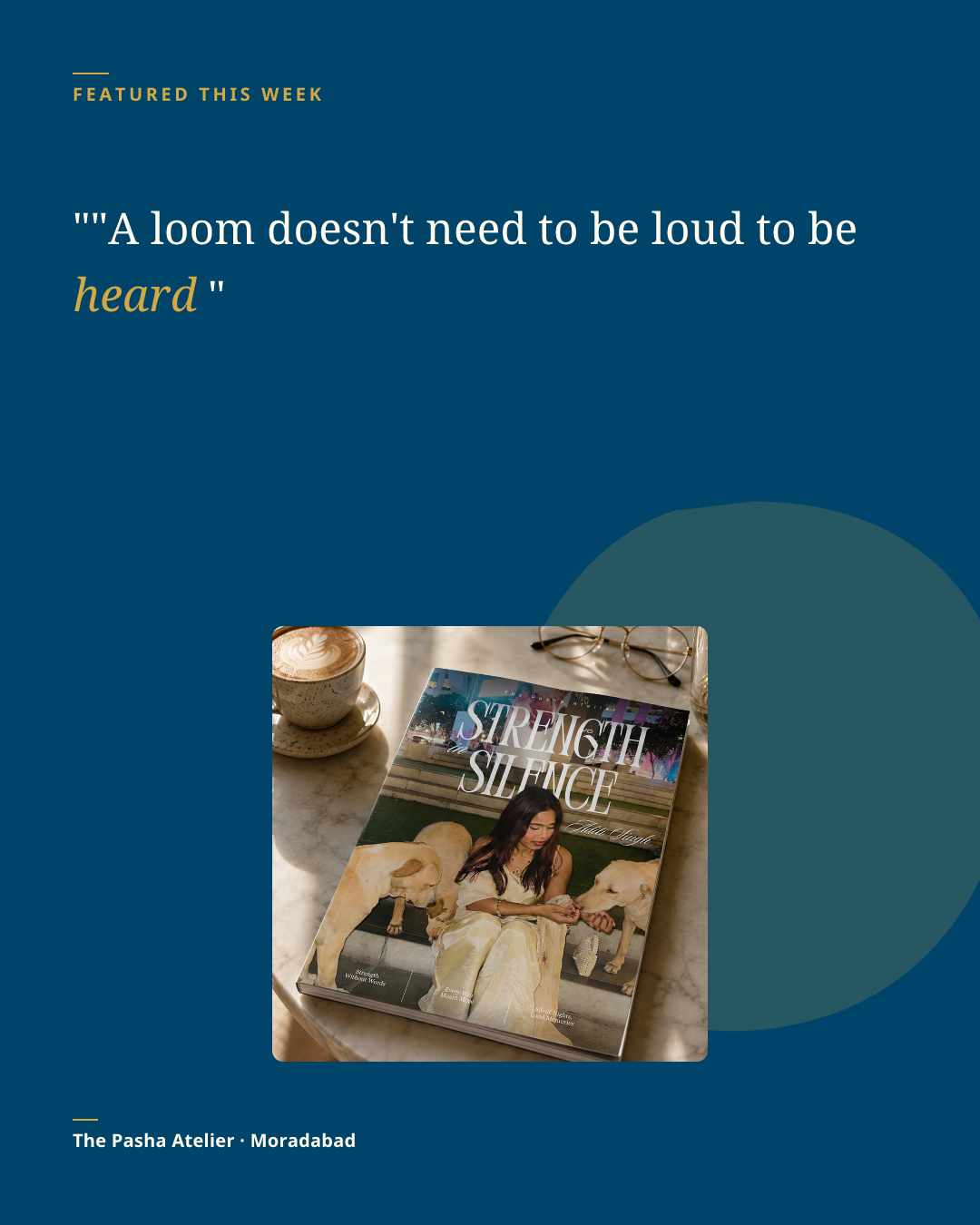
Quote Card layout — pull-quote up top with photo below
Quote Card · Maker voice
Maker Spotlight layout — biographical post about the seller behind the product
Maker Spotlight · Seller story
Buddha Purnima festival post — a real festival fire from the calendar
Festival · Buddha Purnima
Soft Frame layout — quieter, story-led arrangement with organic accents
Soft Frame · Slow-craft
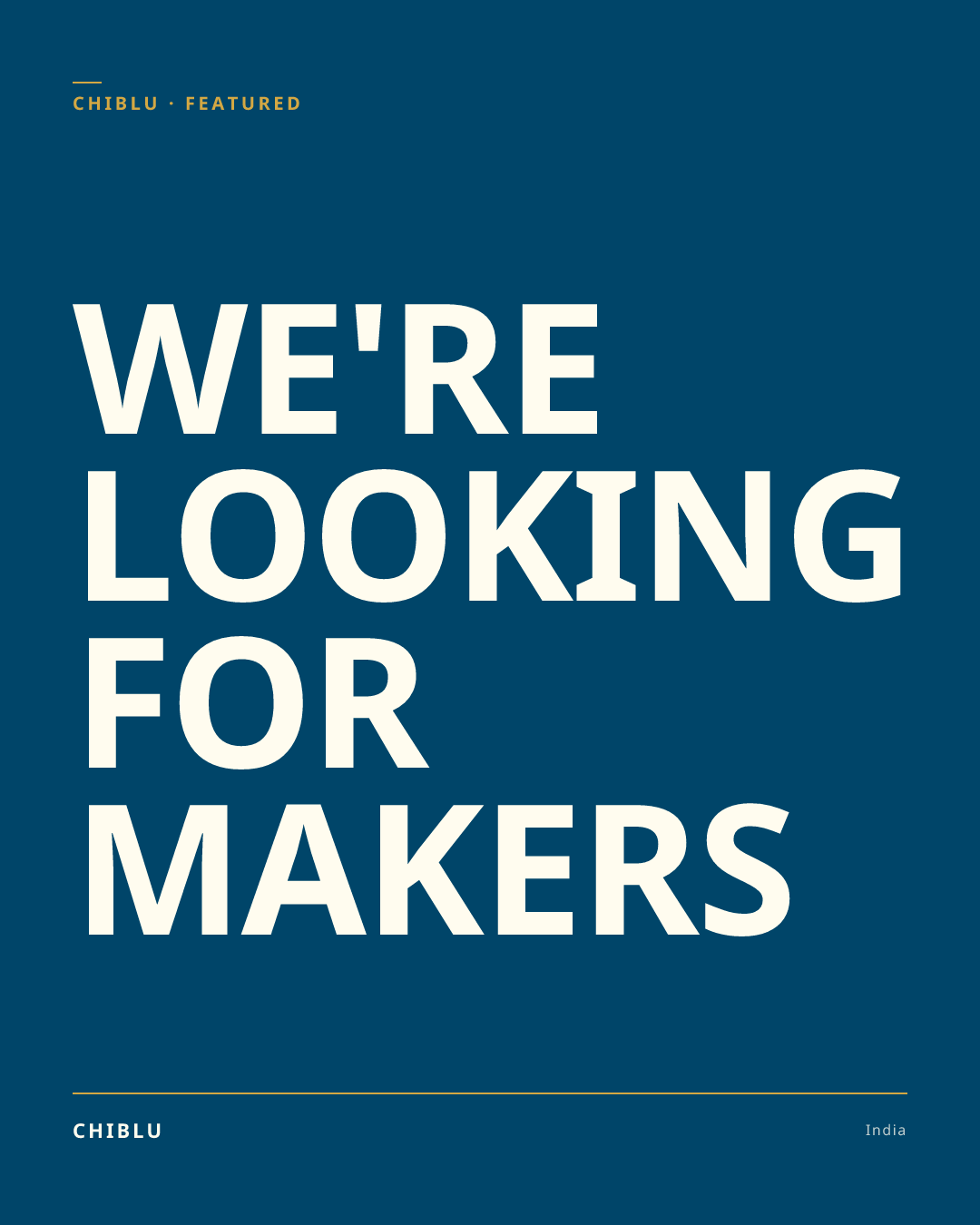
Bold Poster typography — seller-campaign cover with no product photo
Bold Poster · Seller campaign

The agents don't pick the design; we do, once. They just keep using it. Each schedule has a single layout by default, or rotates between two — a single-post one week, a carousel the next. The festival watcher uses one designated festival template across the year.


What emerged

The job changed shape.

When we started we imagined the agents writing the posts and us approving them. That's accurate but it undersells the shift. The actual change: the editorial decisions moved earlier. We're not picking words on Wednesday. We're picking a rotation in January. We're not laying out a Diwali post in October. We're flagging enabled on the festival in advance. The work compresses into a few moments of taste — pick the template, pick the rotation, pick which festivals matter — and then six agents make the consequences happen.

Curator, not creator. Approval, not authoring.

The other thing that emerged: predictability stopped being a constraint and became the point. We can tell you what'll post next Sunday at 10 AM IST. That's not a limitation. That's the whole reason the calendar works.


Notes from the work

Four principles that kept showing up across rewrites.

Approval, not authoring. The human belongs in the decision, not the keyboard. If we're writing the caption, the system has lost. If we're choosing among four already-good variations, the system is doing its job.
Predictable beats clever. The seller-campaign agent walks a list of twelve angles, one per week. The same week of the year always picks the same angle — boring, repeatable. Which means the calendar can tell us on May 1st what'll go out on May 24th. Surprise is a feature only when the receiver chose it.
Make it once, review it all together. Seven Telegram pings spread across the week is worse than one digest on Sunday morning. Making each post the moment it's needed sounds tidy on paper; in practice it interrupts you on the wrong day. Doing it all in advance costs a little more time once, and almost no attention all week.
Brand-color blocks over AI-imagined scenes. We spent a week trying to get an AI image model to paint marketing-poster backgrounds for us. Some looked good. Some looked like stock photos with the saturation broken. A flat brand-color block with bold typography looked more confident every time. The agents now reach for geometry first and AI scenery only when the post specifically asks for it.

How the pieces talk

The skeleton is small.

Three things start a post — a timer, a date on the festival calendar, a new product showing up in the catalog. Agents in the middle turn that signal into a draft. We see drafts on Telegram and on the calendar. The auto-publisher closes the loop into Instagram.

What starts it
A scheduled timer
A date on the festival calendar
A new product appearing
An operator click
What the agents do
Pick what to post about
Write the caption
Make the images
Save and schedule
Where we see it
Telegram digest
Calendar grid
Auto-publisher
Instagram

None of this is novel on its own — a timer, a writer, a renderer, a phone-friendly review surface. The interesting part isn't the pieces. It's that each one does a single thing and stays out of the others' way. Changing how captions get written doesn't touch how the calendar shows what's coming up. Adding a new festival doesn't ripple into the Telegram review flow.

The Takeaway

Built for @chibluindia.

The shape transfers — agent triggers are events, captions are content, designs are templates, and the surface is whichever app you already open on your phone. Anyone running a single-brand storefront with a feed they keep forgetting to update could swap the product source, the brand kit, and the IG account and get the same loop.

We still post the occasional thing manually. Some days a maker sends a photo and we want it up in 20 minutes, not next Sunday. But the spine of the feed — the predictability, the festival coverage, the steady recruitment to chiblu.com/seller — that runs without us. It runs on Sunday mornings, on six small agents and a sliver of taste.