Open Source · The Redrawing

A designer redrew an AI trading framework.
For an Indian trader's morning.

An open-source trading framework that never met its user. Redrawn for the morning an Indian retail trader opens NSE.

0
Config files
10
AI agents
NSE/BSE
Native
Real-time
Live pipeline
The starting point

Ten agents. Two thousand stars. No user.

TauricResearch/TradingAgents is a serious piece of research - a multi-agent LLM framework that simulates a trading firm. Ten agents argue through a stock the way a real desk would: analysts read the market, bull and bear researchers debate, a risk team stress-tests, a portfolio manager decides.

It also assumed you were a developer who already knew your ticker.

That's an engine, not a product. A designer's question arrives here:

What would this look like if a designer started from the user's day - not the engine?

The rest of this is the answer - one screen at a time.

9 AM · Discover

What's worth looking at today?

The first question of a trader's morning isn't "what's the answer on this ticker?" - it's "which ticker is worth my attention?" The original framework had no answer. Three screens, each calibrated to a different angle of that question.

Module 01

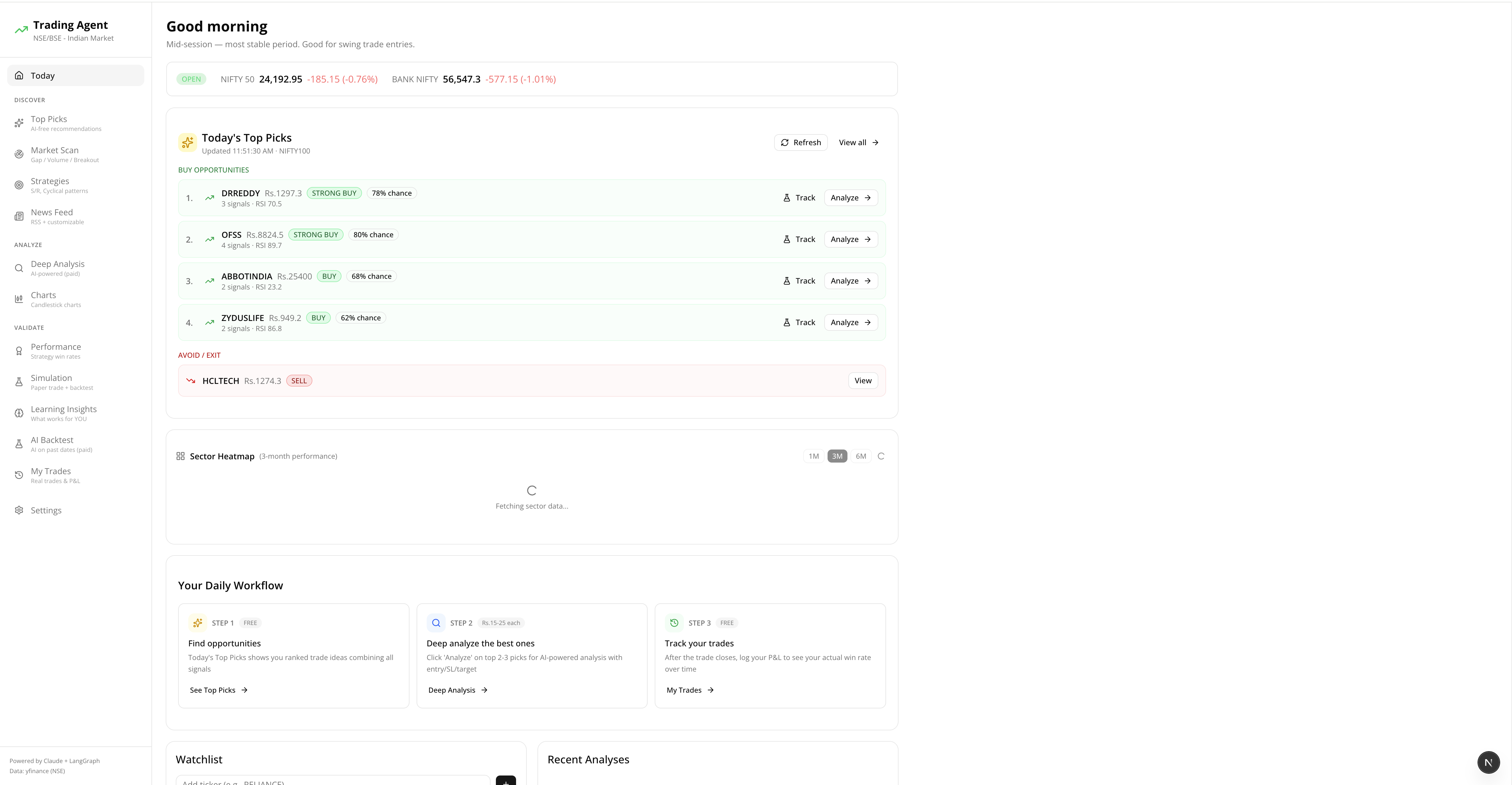
Today - The morning is the feature

The starting page answers "what's worth looking at?" before you ask it.
Open app NIFTY live + session badge Top Picks auto-compute Sector heatmap fills You read, not search
  • Session-aware greeting - "Market opens in 15 min", "Mid-session - good for swing entries", "Last hour - tighten stops". Context changes what you focus on.
  • Top Picks auto-load - by the time you've read the market status, your trade ideas are ready. Zero clicks.
  • Sector heatmap - 3×3 grid. Where money's flowing, in two seconds.
  • "Next Step" card on every screen - a small pattern, repeated. Users never wonder what to do after.
Today - the daily starting page with live indices, auto-loaded Top Picks, and sector heatmap
The morning is the feature. Everything auto-loads - no clicks needed to start.
Module 02

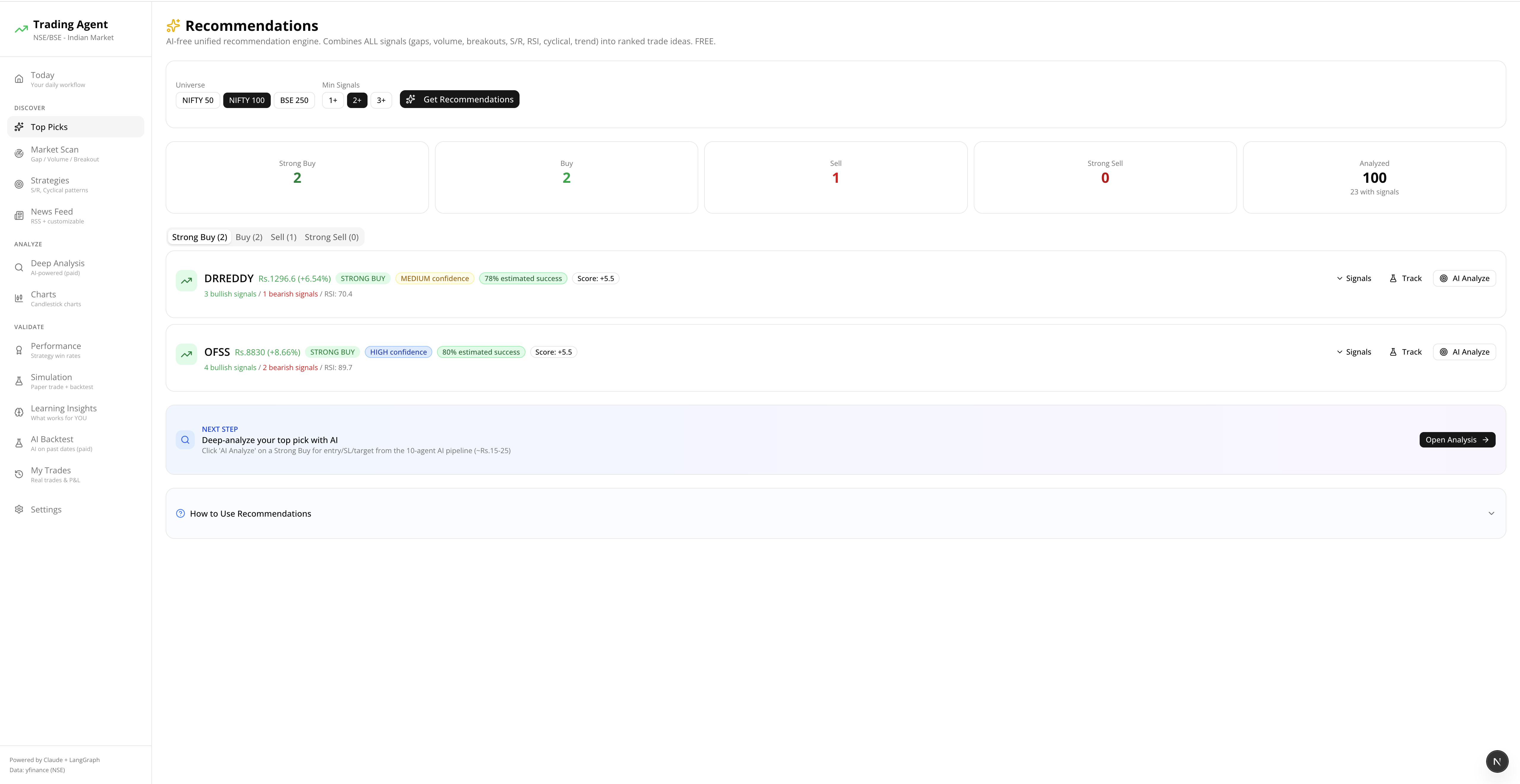
Top Picks - Browsing should feel free

A math-based ranking engine. No AI calls. Free to browse, every scan.
NIFTY 100 universe 10+ signals fire Weighted by win rate Ranked list Track or Analyze
  • 10+ signals combined - gap patterns, volume breakouts, RSI levels, S/R proximity, cyclical seasonality, trend direction. Each weighted by historical win rate.
  • Confidence + estimated success - HIGH / MEDIUM / LOW on signal alignment, 50–85% probability, no false precision.
  • Expandable "Signals" view - click to see exactly which signals fired and their point contribution. No black box.
  • One-click Track - opens a paper trade with full context captured (source, strategy, every triggered signal, score).

The design claim underneath: users feel like they're spending money just by browsing - and that anxiety kills product use. Separating discovery (math, free) from depth (AI, paid) changes the felt experience from "pay to look" to "look as long as you want." The AI only runs on the 2–3 tickers you've already decided are worth it.

Top Picks - AI-free unified recommendations with signal counts, confidence, and track/analyze actions
Browsing 100 stocks costs nothing. The AI only runs on the one you've decided to commit to.
Module 03

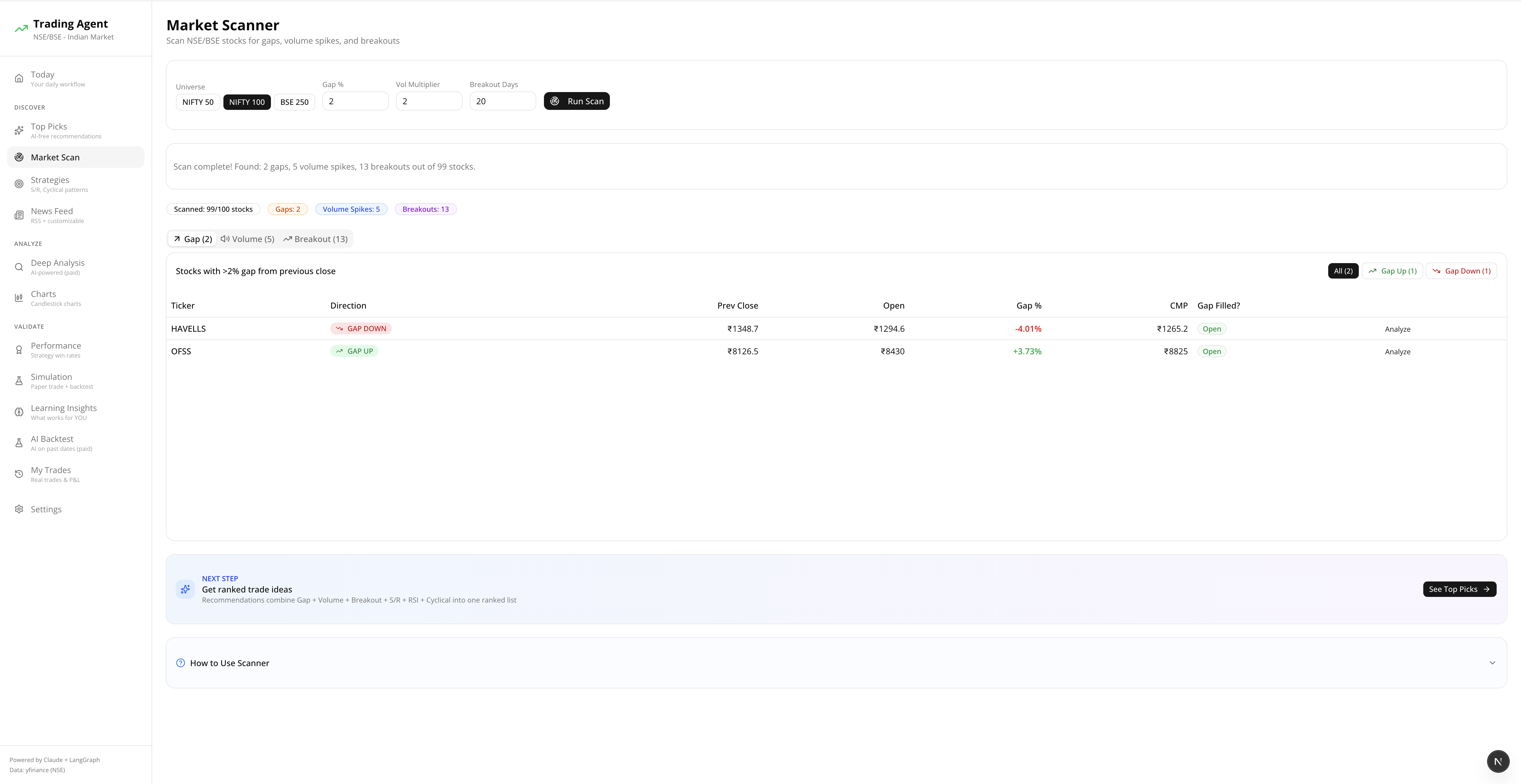
Market Scanner - Tuned for the Indian morning

Gap, volume, breakout - calibrated to the signals Indian retail traders actually trade on.
Pick universe Run scan Gap · Volume · Breakout 3 result tabs One-click analyze
  • Gap Scanner - overnight gaps from US/SGX Nifty cues. Tracks whether the gap was filled (buyers defended vs sellers won) - a signal US-market scanners don't surface.
  • Volume Spike - stocks at >2× average. In India, that usually reads as FII or DII activity - one of the strongest signals retail traders follow.
  • Breakout - above 20-day high with volume confirmation. Volume-confirmed breakouts historically win more often than unconfirmed ones.
  • Analyze link per row - one click takes you from a scan hit straight into the 10-agent deep analysis for that ticker.
Market Scanner - Gap, Volume, and Breakout scans with Gap Filled status and analyze shortcut
The signals aren't generic. They're the ones that actually move on NSE/BSE.
Midday · Analyze

Why is this one worth my money?

By midday, the Discover layer has done its job - you've found two or three tickers worth a second look. Now the AI runs. But not the way it did in the CLI.

Module 04

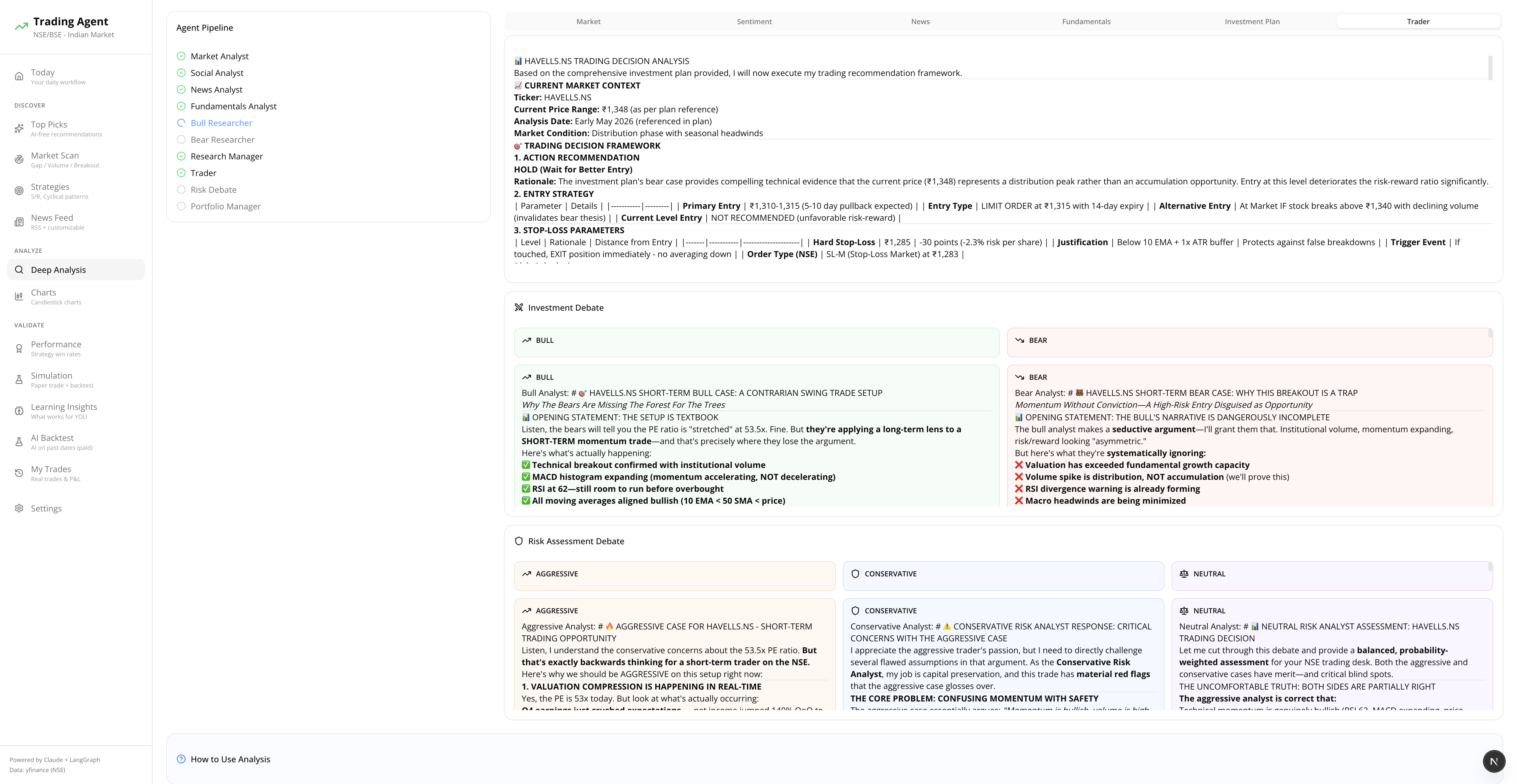
Deep Analysis - Let the user watch the debate

The 10-agent pipeline redrawn as a glass box. Live heartbeat, visible arguments, readable decision.
Pick analysts + depth Run pipeline Live heartbeat (WebSocket) Bull vs Bear debate Decision + entry / SL / target
  • Live heartbeat via WebSocket - "calling get_indicators: RSI, MACD…" updates every few seconds. You never wonder if it's still thinking.
  • Bull vs Bear side-by-side - two columns, same decision under scrutiny. Risk debate renders as three columns (Aggressive / Conservative / Neutral).
  • Agent progress sidebar - 10 agents, each in pending → running → complete. Report tabs auto-advance as the pipeline moves.
  • Decision card + Position Sizer - final answer with entry, stop-loss, targets. The sizer takes your capital + risk % and computes shares to buy from the agent's levels.

What the designer noticed: a black-box "BUY" doesn't earn trust - seeing the debate does. Transparency isn't a feature here; it's the whole reason a user would run the pipeline a second time. The build had to make every internal step visible, which meant designing the UI alongside the agent graph - not after it.

Deep Analysis - the 10-agent pipeline rendered as tabbed reports, bull vs bear debate, and a decision card
The engine is the same ten agents. The screen is what turned them into a product.
Afternoon · Validate

Did the system actually work?

Indian retail has been burned by signal-selling groups on Telegram and YouTube. Trust isn't assumed here - it has to be earned. Every system that wants a retail trader's money first has to show its receipts.

Module 05

Simulation - Earn trust with data

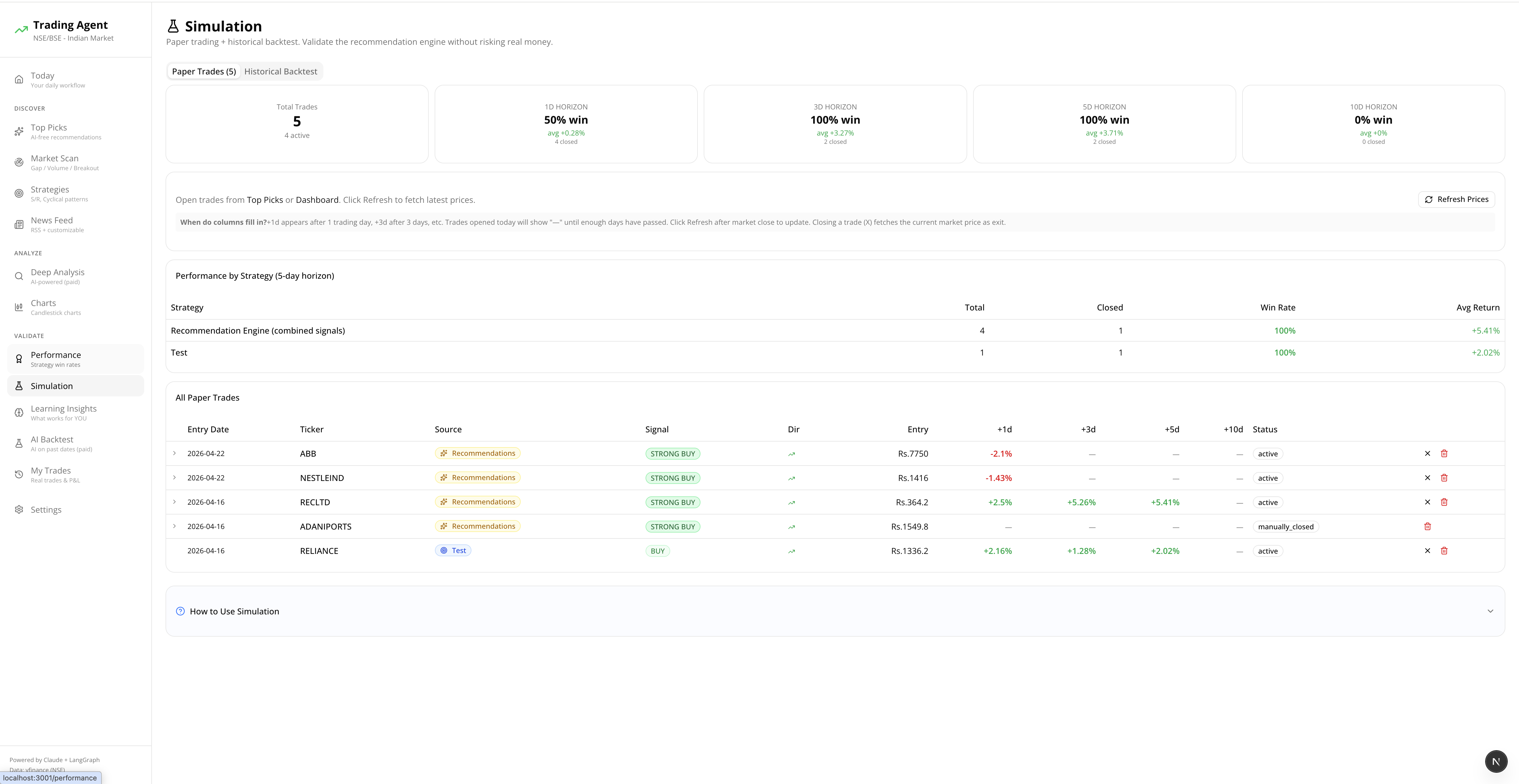
Paper trading, horizon tracking, performance by strategy. All before any real money.
Track from any screen Snapshots at 1 / 3 / 5 / 10 days Refresh fetches live prices Performance by strategy Real trade, with confidence
  • One-click Track from any screen - Recommendations, Scanner, or Dashboard. Captures full context: source, strategy, every triggered signal, score.
  • Horizon columns: +1d / +3d / +5d / +10d - is this a day trade or a swing? If +1d is red but +5d is green, the strategy needs patience - not panic-selling.
  • Performance by Strategy - win rates grouped by source. Learn which screens win for YOU, not a generic benchmark.
  • Honest about losses - closing a trade fetches live market price and computes final P&L. Tracks red trades the same way as green ones.

What the designer noticed: paper trading isn't a feature - it's the onboarding. Two to three weeks of tracked paper trades turn "can I trust this?" into a data question. The build had to auto-fetch prices at the right horizon markers (1 / 3 / 5 / 10 trading days - skipping weekends and NSE holidays) and surface win rates per source, otherwise the trust claim doesn't hold.

Simulation - paper trades with horizon win rates, performance by strategy, and a per-trade table
The screen earns trust, one tracked trade at a time.
The invisible redesign

The screen no one credits

Every product has one screen that determines whether anyone actually uses it. For this one, it wasn't the AI pipeline or the scanner. It was Settings.

Module 06

Settings - The .env file, killed

The smallest UI change. The biggest adoption consequence.
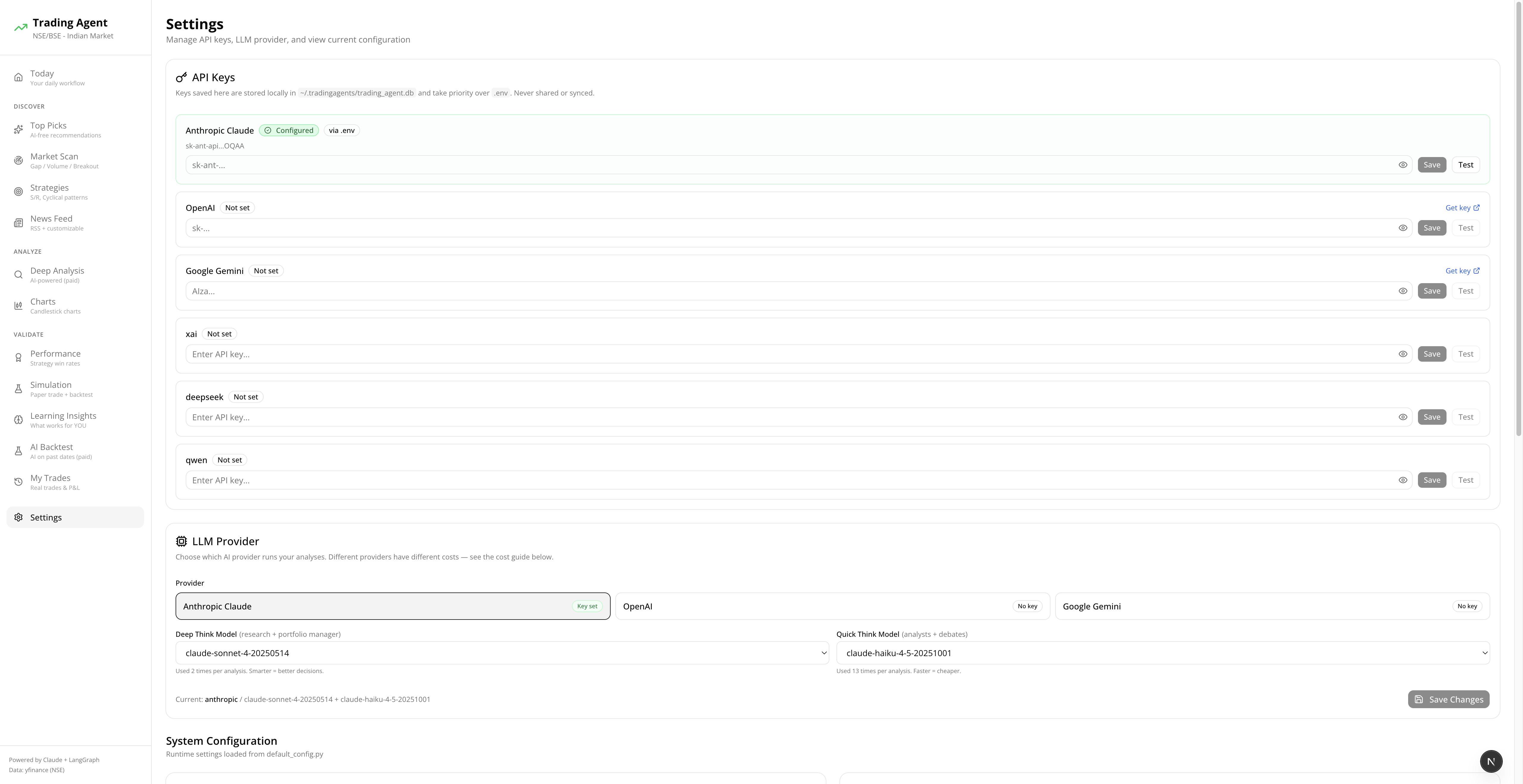
Paste key into a card Click Test "Configured" badge Save Analyses start working
  • 6 provider cards - Anthropic, OpenAI, Google Gemini, xAI, DeepSeek, Qwen. Visual cards, not a config schema.
  • Save + Test, side by side - Test fires a tiny real API call. You know your key works before you run an expensive pipeline.
  • Masked display - once saved, only the tail shows (sk-ant-api…OQAA). Never leaks the full key in the UI again.
  • Deep Think vs Quick Think split - Sonnet runs for the 2 critical agents, Haiku handles the 13 fast ones. Auto-populated when you pick a provider.

The smallest UI decisions matter most. A .env file is a tax on anyone who isn't a developer. Moving the key-entry into a screen - paste, Test, Save - is worth more to adoption than any AI feature in the product. No one writes a case study about their Settings page. But without this one, nothing else gets used.

Settings - six API provider cards with Save and Test buttons, LLM Provider switcher, Deep Think and Quick Think model selectors
The smallest UI change in the entire redrawing. And the one that made the rest of it matter.
What emerged

A loop no one designed

The most interesting thing wasn't any single feature. It was that, once the screens were drawn correctly, they started to connect - without anyone planning the connection.

Recommendation Track Horizons fill Win rates Insights Agent memory

Every paper-trade click writes to three screens at once. The tracked outcome feeds the win-rate tables. The win-rate tables feed the Learning Insights view. The insights feed the next run's agent memory - which shapes what the next Recommendation ranks highly.

This wasn't designed upfront. It emerged because every individual screen stored enough context for the next one to use. Click Track on Recommendations, and the paper trade remembers the source, the strategy, every signal that fired, the score. That metadata is what made the loop possible. Design each screen like it has to explain itself to the next, and the loop falls out for free.

The builder's dividend: doing the small things right makes the big thing emerge.

Notes from the work

Four things that held up

Designing and building this top to bottom, the same truths kept being right at every decision point:

The takeaway

A designer redrew the screens. A builder wired them up.

The engine was ten AI agents, a paper, and 2,000 stars. The product was everything that came after: a morning, a workflow, a trust protocol, a Settings page people actually fill out. Both halves mattered - neither would have worked alone.

Built on TauricResearch/TradingAgents · Apache 2.0 · Open source at github.com/pradeepsiddappa/indian-trading-agent