An experiment in using AI to handle repetitive seller outreach while keeping human judgment in the loop.
While building Chiblu, I found myself spending a lot of time finding makers, starting conversations, answering the same questions, and following up. The work was repetitive, but the conversations that mattered still needed a person. So I explored what would happen if AI handled the repetitive parts while I stayed in control of the moments that needed judgment.
Chiblu was a curated marketplace for independent makers. The buyers were on Instagram, the sellers were on Instagram, and I was one person. Every week looked the same:
Finding makers across seven crafts, qualifying them, writing hundreds of personalised messages a week, replying to every “hi” within minutes, answering the same questions about commission and GST and why anyone should switch, and keeping track of all of it.
None of it was hard. There was just far more repetitive conversation than one person could hold.
Not a drip campaign and not a chatbot. Something that could carry the routine half of a conversation and know where its half ended.
Identify makers actually worth approaching, open the conversation in a voice that sounded like us, understand what had already been said, answer the questions that came up every time, follow up when a thread went quiet, and recognise the point where it should stop and get me.
The goal was never full autonomy. The interesting design problem was the boundary: teaching the system to recognise when judgment mattered and to get out of the way cleanly.
“Talk to a Human” is the whole idea in one control. Asking for a person pauses the automation and gives the thread back to me with everything that was said already intact. I answer, and the system picks up again when I am done. Nothing is lost in the handover, which is the part that makes it usable rather than a novelty.
The system also knew when not to answer at all. Messages that looked like spam, or pasted walls of text, got a short fixed reply rather than an improvised one.
The dashboard is where discovery and outreach happen. Makers get grouped by craft, because a message that works for someone making ceramics does not work for someone making jewellery, and the pitch changes depending on the size of their following.
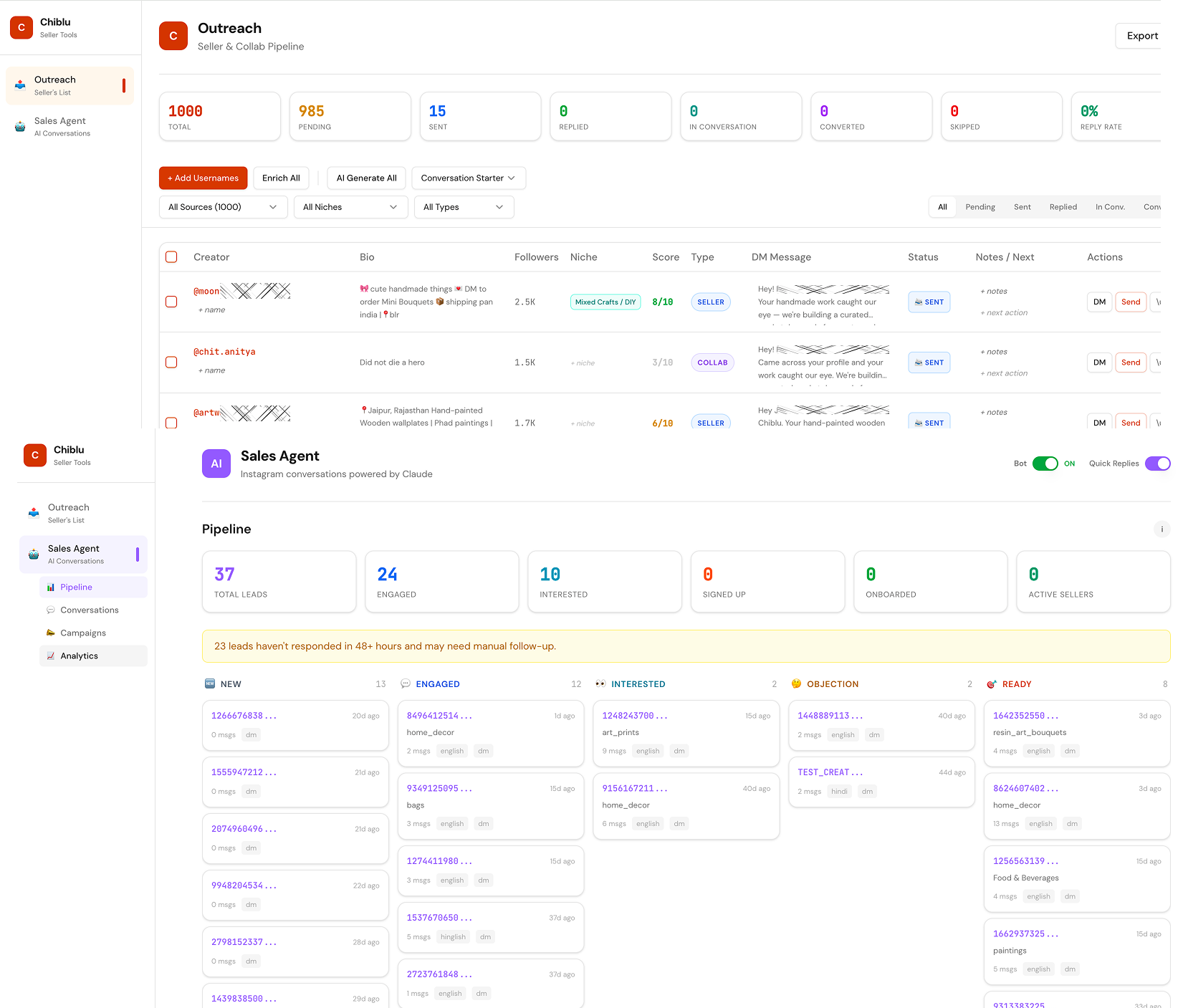
Every maker in one list, grouped by craft, with the draft message ready to review before it goes anywhere.
Drafts were never sent automatically. I read each one and sent it myself. Automation started once someone replied.
AI was most useful removing repetitive work, not judgment. The value was never in it deciding anything. It was in it carrying the first ten exchanges so I could be present for the one that mattered.
The handoff is part of the product. A workflow like this lives or dies on the boundary between what is automated and what is not, and on whether crossing that boundary loses anything.
Context matters more than a clever reply. The system only became useful once it understood what had happened earlier in the thread. A good answer to the wrong question is still the wrong answer.
The Chiblu Assistant handled the repetitive part of the conversation so I could spend my time on the conversations that actually needed a human.
A small experiment in designing around AI: not removing the person from the workflow, but deciding where the person mattered most.